
DRL/Development/DRL Studio

DRL Studio

DRL's in-house digital rock physics engine: image-based 3D modeling and pore-scale simulation of porous rocks in a single cross-platform desktop application.

overview

From images to digital rock.

DRL Studio is the in-house digital rock physics platform that powers every DRL imaging service and every research study we run. The application takes raw 3D image data from any modality DRL works with (e.g., micro-/nano-CT/-XRM, FIB-SEM, SEM, S/TEM) and produces a segmented, quantified digital rock 3D model on which pore-scale simulations can be run.

The platform is in active development: continuously improved, tested, and benchmarked as we apply it to new rock systems. It runs cross-platform, leverages modern GPU/multi-GPU compute, and is built on a modern open Python stack that keeps every step of the analysis and simulation pipeline extensible.

capabilities

Image → model → simulation.

Three stages, one application. Designed end-to-end for digital rock physics workflows.

Stage 01

Image processing

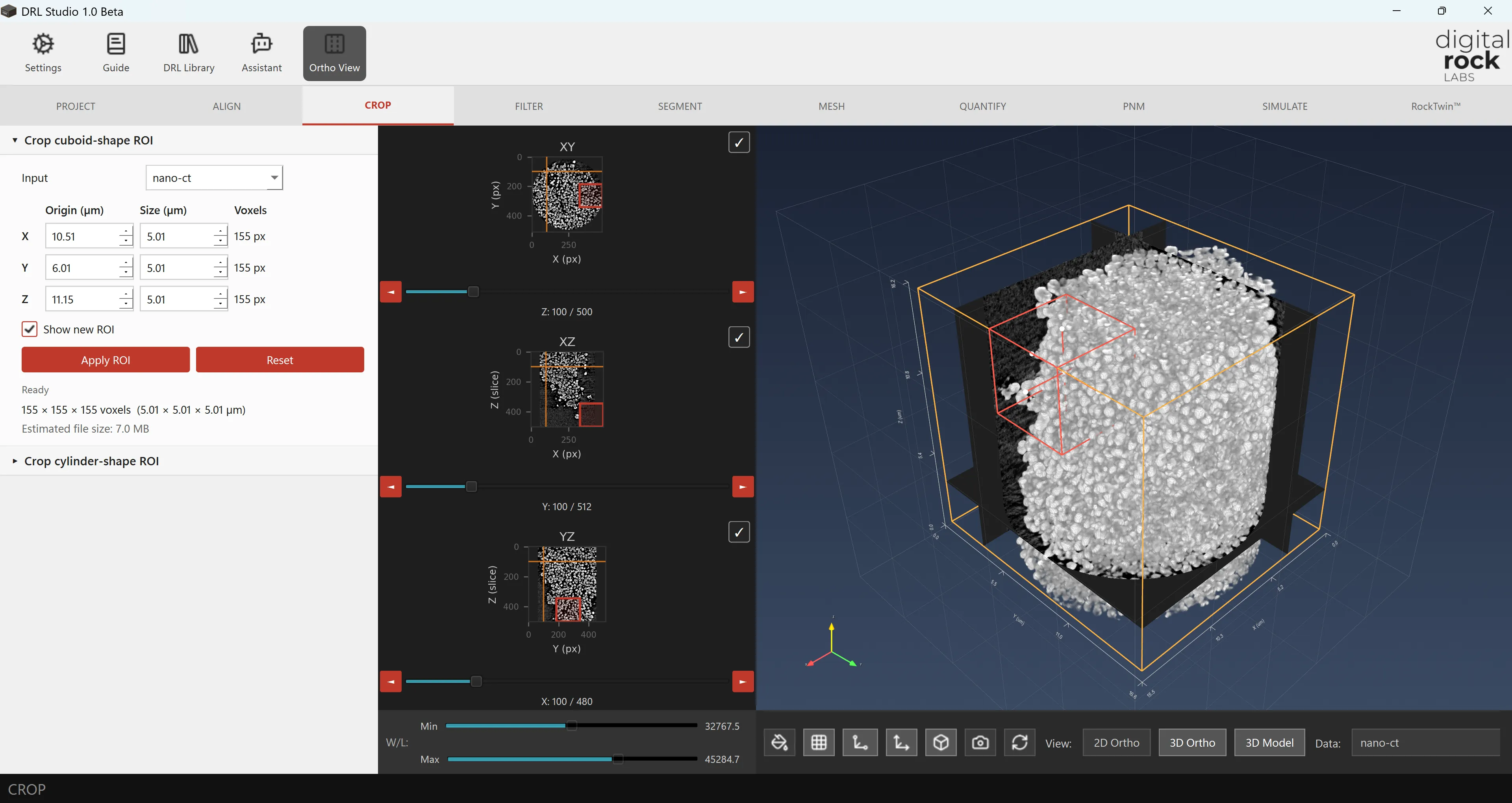
Ingests tomographic image datasets across DRL's imaging modalities (e.g., micro-CT/-XRM, nano-CT/-XRM, SEM (mosaic) maps, FIB-SEM and S/TEM nanotomography). Handles alignment/registration, filtering, 3D reconstruction, etc., so multi-modality datasets can be unified into a single representation.
Stage 02

Segmentation & 3D modeling

Builds segmented digital rock 3D models using both classical and machine-learning / deep-learning segmentation, calibrated for the multi-phase mineral systems where threshold-based approaches fall short. The AI-assisted segmentation improves with every user correction.

Stage 03

Pore-scale simulation

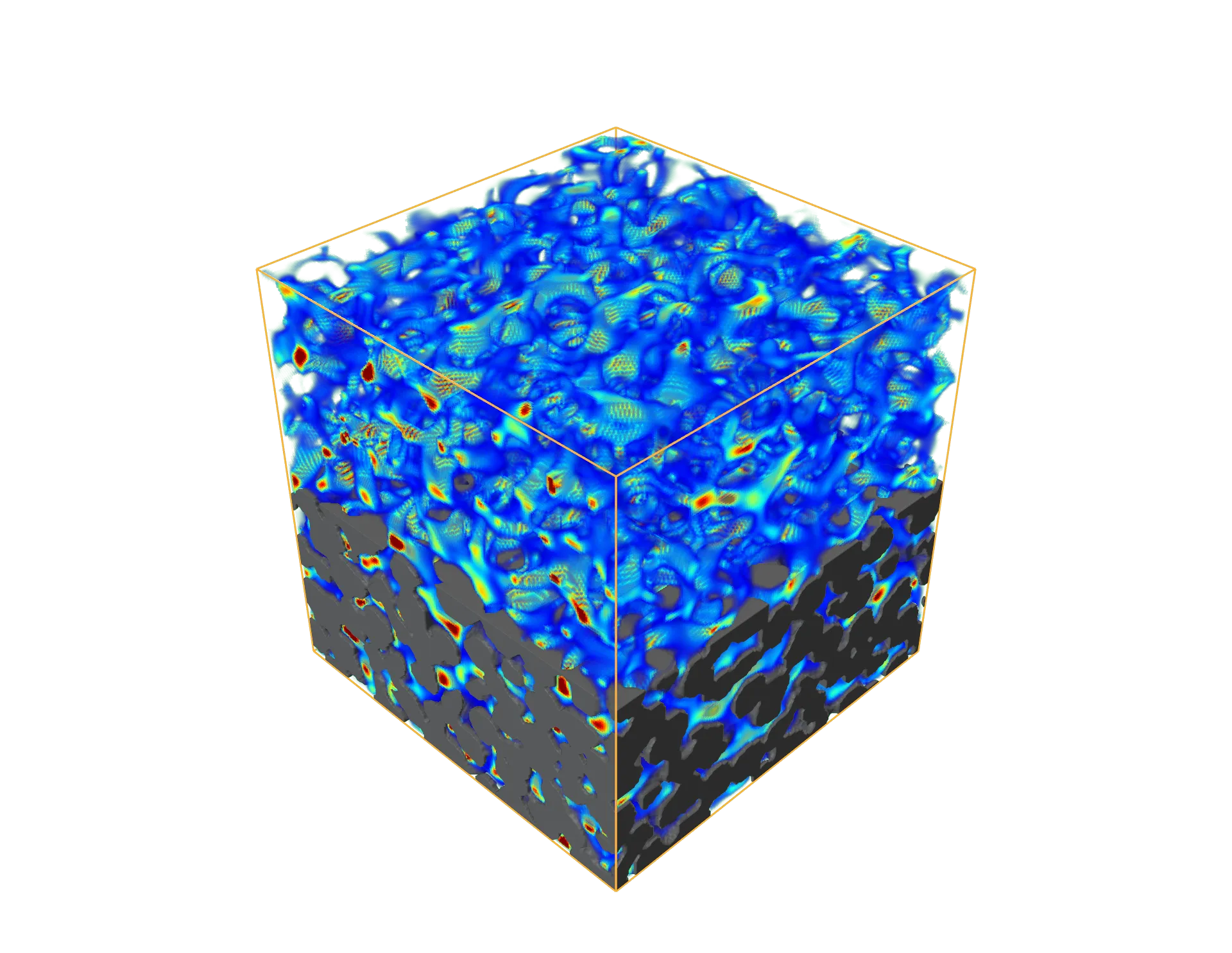
Runs physics-based simulations directly on the digital rock: single- and multi-phase fluid flow, solute transport, and effective physical properties.

Visualization of a 3D digital rock model reconstructed from tomography image datasets using DRL Studio.
petrophysics

Measurable properties, directly from the rock.

Directly from the digital rock 3D models, DRL Studio extracts measurable properties of the imaged rock. Examples of what we can compute:

  • Total and effective (connected) porosities
  • Pore-system topology, connectivity, and tortuosity
  • Pore and mineral phase volume fractions and surface areas
  • Pore-network model
  • Pore- and grain-size distributions
  • Permeability and relative permeability
  • Mercury intrusion capillary pressure (MICP)
  • Formation factor, electrical and thermal conductivity, and effective diffusivity

Among other modeled and simulated petrophysical properties.

performance

Fast and trustworthy.

DRL Studio scales automatically across CPU cores and GPUs, with multi-GPU acceleration for heavy compute. The platform runs on Windows, macOS, and Linux, dispatches each operation to the fastest available compute path, and is built on a modern open Python stack that lets us extend the analysis or simulation pipeline as research demands evolve.

Universities, national labs, and research institutions:
We welcome partnership on current and future research projects that build on DRL Studio.

Contact us