Multi-scale ore characterization
Ingests correlative datasets from micro-CT/-XRM, SEM/EDS, FIB-SEM, and S/TEM into a unified digital ore representation across scales, using DRL Studio as the data backbone.

Pore-scale physics, upscaled to the field. A multi-scale simulator for mineral and energy reservoir-system prediction.
RockTwin is a multi-scale, physics-based simulation platform for predicting the performance of heap leach, in-situ recovery, and unconventional oil and gas reservoir systems. Built on DRL Studio, it extends pore-scale capability to field-relevant length and time scales through a hierarchical chain of models that span the nano- and micro-scale of rock material, the scale of single rock particles, and the scale of the engineered or natural reservoir system.
Conventional simulators operate at the continuum (Darcy) scale and depend on effective parameters – accessible reactive surface area, dispersivity, effective rate constants, dynamic porosity-permeability evolution – that cannot at present be predicted from rock structure and are instead fitted or assumed. The resulting predictions of recovery and breakthrough routinely miss field behavior, often by orders of magnitude. RockTwin will close this gap by upscaling each effective parameter from the physics resolved at the scale below, rather than carrying it as an unconstrained input.
The platform is designed to accommodate physics-based constitutive relations (closure laws) derived from ongoing reactive-transport research, including accessible reactive surface area, laboratory-to-field reaction-rate corrections, and the dynamic coevolution of porosity and permeability under flow.
The modular design we are building, with every module image-grounded and physics-based, directly inheriting DRL Studio's image analysis and digital rock construction.
Ingests correlative datasets from micro-CT/-XRM, SEM/EDS, FIB-SEM, and S/TEM into a unified digital ore representation across scales, using DRL Studio as the data backbone.
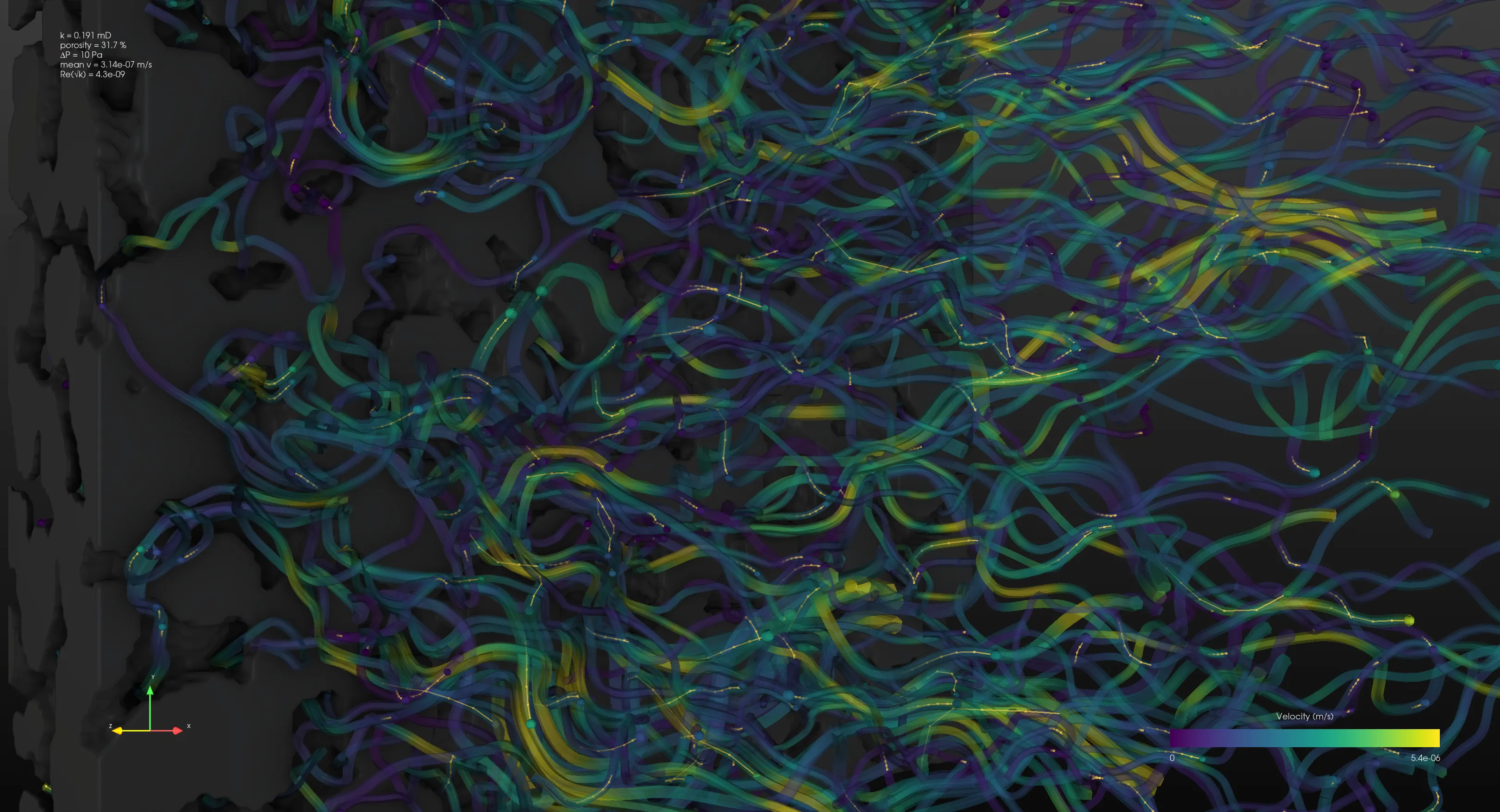
Simulates fluid flow, solute transport, and geochemical reactions on the digital rock, resolving dissolution fronts and pore-geometry evolution.
Predicts recovery curves, reagent consumption, and effluent chemistry from ore microstructure inputs, for engineered heap design and operational forecasting.
Couples dissolution-driven mechanical weakening with stress and deformation models for heap-stability assessment and structural-integrity forecasting.
Coupled thermal-hydraulic-mechanical-chemical solver, capturing the feedbacks between temperature, flow, deformation, and reaction that govern real recovery operations.
Surrogate models trained on full physics runs to deliver rapid property predictions and scenario screening at engineering speed.
Universities, national labs, and research institutions:
We welcome partnership on current and future research projects that build on or accelerate RockTwin's development.